

The Navigator provides insight into stock market activity and offers a outlook
October 10, 2026
On the surface, the third quarter of 2026 presented a familiar picture: The major indices moved sideways or rose slightly, with no signs of unusual turbulence. Beneath the surface, however, the gap between a small group of tech heavyweights and the broader market continued to widen—while at the same time, the price of gold took a long-overdue breather after a historic rally. Both developments essentially tell the same story: If you don’t look closely, you’ll only see the tip of the iceberg.
Market review
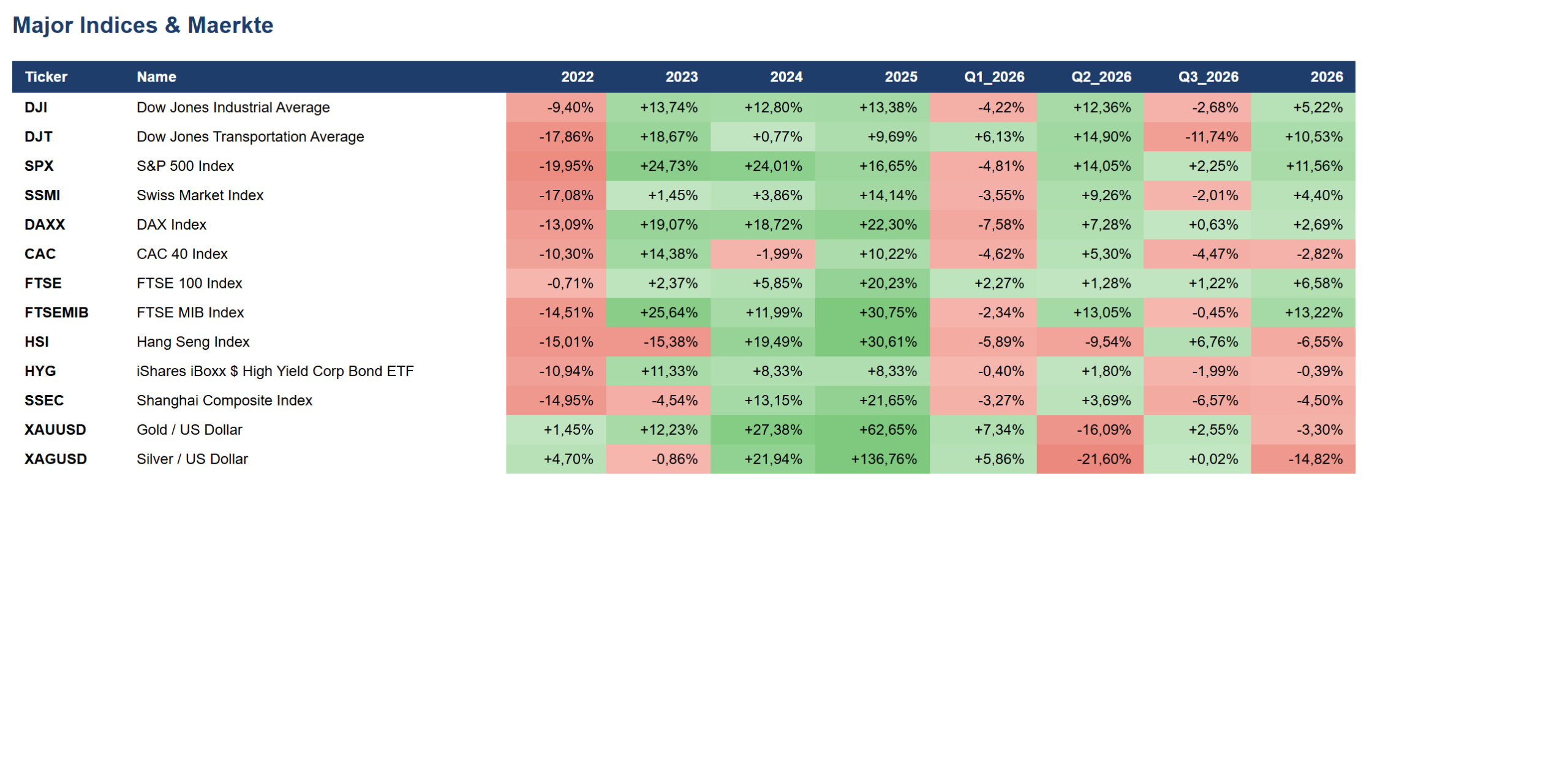
The S&P 500 closed the third quarter with a moderate gain of +2.25%, while the Dow Jones fell by –2.68%—an early sign that the broad, more equally weighted indices could no longer keep pace with the technology-heavy S&P. In Europe, the picture was similarly mixed: the DAX was virtually unchanged (+0.63%), while the Swiss Market Index was down 2.01% and the CAC 40 was down 4.47%. Details on the major indices and markets (as of September 30, 2026) are shown in the table below:
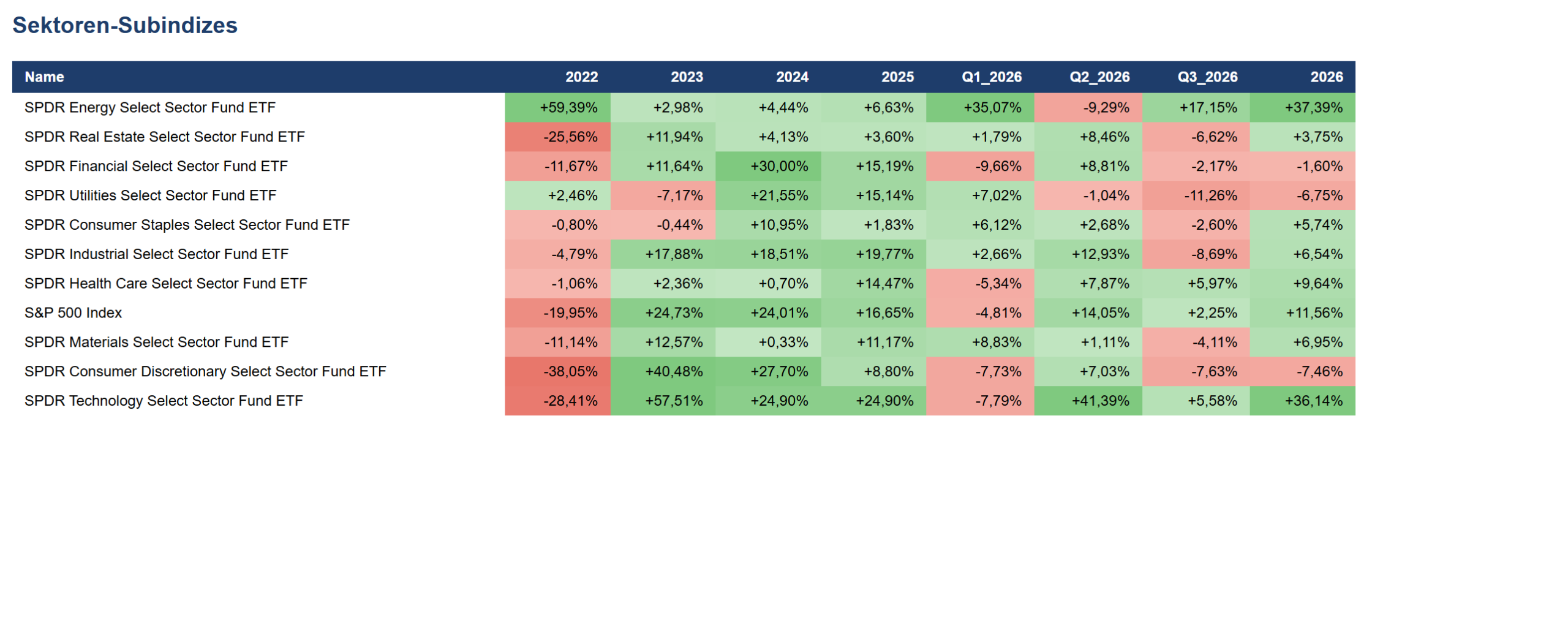
At the sector level, the divergence was even more pronounced: Technology rose by +5.58%, and Energy—after a weak second quarter—rebounded strongly by +17.15%, while Utilities (–11.26%), industry (–8.69%), and consumer discretionary (–7.63%) came under significant pressure. An overview of the sector sub-indices:
The performance of precious metals was particularly noteworthy: Following an extraordinary year in 2025 (gold up 62.65%, silver up as much as 136.76%), a sharp correction occurred in the second quarter of 2026, which continued and consolidated in the third quarter — Although gold ended the third quarter slightly up at +2.55%, it remains about 20% below its January high of around USD 5,589. Silver closed the quarter virtually unchanged (+0.02%) after falling sharply in July from its January high of USD 121.67.
In focus
Two developments characterized the third quarter; at first glance, they seem to have little to do with each other, but upon closer inspection, they follow the same pattern: concentration fuels a rally only until it no longer does.
First, the breadth of the stock market. As of the end of September, the S&P 500 was trading only about 2% below its 52-week high—a picture of apparent strength. Behind this, however, lies a considerable weakness in market breadth: About 83% of the index components were trading more than 10% below their respective 52-week highs, and 42% were even more than 20% below them. In September alone, technology was the only sector to post a notable gain (+5.1%), while financials and materials fell by more than 7%. The so-called “Magnificent Seven” now account for a good third of the S&P 500’s total market capitalization—and are valued at about 31 times expected earnings, compared with about 20 times for the remaining 493 index constituents. This valuation gap is not necessarily a cause for alarm (these companies’ earnings momentum is real), but it does mean that a significant portion of the index’s return hinges on just a few stocks.
Second, the correction in gold and silver. Following the extraordinary rally of 2025 and another peak in January 2026, a classic intracyclical correction occurred: By the end of September, gold was trading about 22–24% below its annual high, while silver had given back an even larger portion of its gains. Between the end of August and the end of September alone, gold lost about 6.7%, with a single-day decline of over 4% at the end of September, triggered by rising oil prices and the associated renewed expectations of interest rate hikes. Such sharp—though historically not unusual—interim corrections are the price one pays for participating in a structural uptrend; they differ fundamentally from a trend reversal.
What do these two observations have in common? In both cases, an exceptionally strong, concentrated movement (spanning years for technology stocks and just a few quarters for precious metals) reached a point where expectations were so high and positioning so one-sided that even moderate triggers—such as interest rate expectations or a rotation—could lead to noticeable setbacks. Those who have bet exclusively on the winners of recent years—whether a handful of technology companies or precious metals—feel the impact of such corrections far more acutely than a broadly diversified portfolio.
Outlook
In our view, the third quarter of 2026 offers a lesson in two parts. The first part: A tight race at the top of the index—no matter how impressive the underlying earnings momentum of the major technology companies may be—is no substitute for broad-based support. Valuations exceeding 30 times expected earnings set the bar high, and anyone paying significantly more than the market average for a unit of future earnings bears a correspondingly higher valuation risk. This is not an argument against growth stocks—we believe a certain amount of “spice” in the form of growth and momentum is part of a balanced portfolio—but it is an argument against relying on a single, already highly valued segment of the market.
Part Two: The correction in gold and silver shows that even an intact structural uptrend—driven by central bank purchases, geopolitical uncertainty, and long-term expansionary fiscal policy—does not follow a linear path. Those who hold this position as part of a diversified portfolio, rather than as an isolated speculative investment, were able to ride out this volatility without losing sight of the big picture.
Our approach therefore remains unchanged: a core of value-oriented, soundly valued positions—where we do not pay too much for a unit of future earnings—supplemented by a controlled allocation to growth and momentum, broadly diversified across asset classes and regions. Not because diversification is exciting, but because it makes all the difference precisely in quarters like this one—when the tip of the iceberg glistens but the base shows cracks. Over time, it is precisely this steady, consistent growth that allows the power of compound interest to fully take effect.
“Diversification is protection against ignorance.” – Warren Buffett
, EDURAN AG