

The Navigator provides insight into stock markets, with an outlook.
07 July 2026
“Ceasefire Rally”. What cost the market oil, gold, and nerves in the first quarter, it got back with interest in the second: a fragile ceasefire in the Gulf, a new, more hawkish Fed chair, and a technology sector in full swing drove the S&P 500 to its best quarter since the 2020 pandemic rebound.
Market Review
After the shock of the first quarter, April brought initial relief: a ceasefire between Israel and Iran – fragile, and accompanied by renewed tensions well into June – allowed oil prices to retreat from their peak above USD 100. Gold, which had already broken down in the first quarter, lost further ground: from its January highs around USD 5,600 to an interim low near USD 3,960, before stabilizing around USD 4,850 in the wake of the ceasefire (8 April). Silver followed the same pattern, pulling back sharply from its record highs near USD 120.
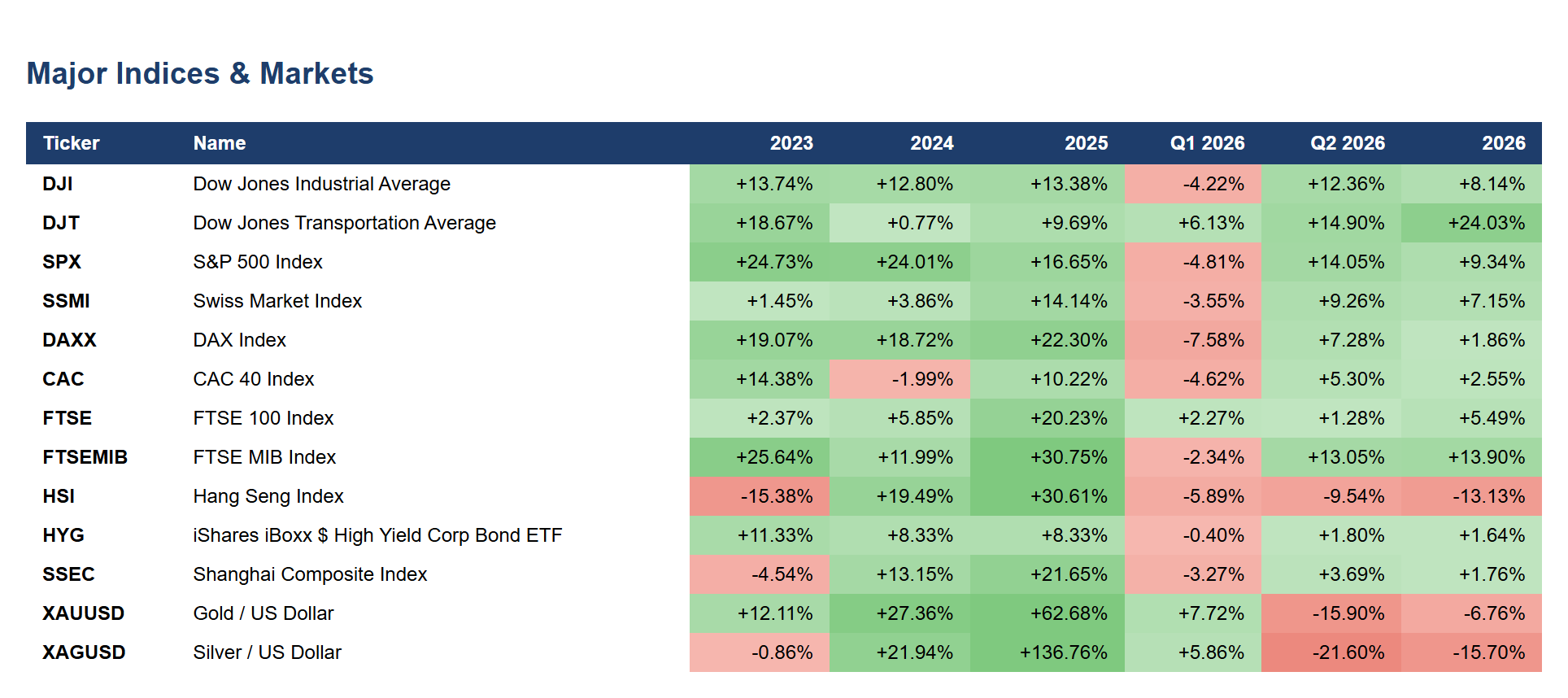
The change at the top of the US Fed made headlines in May/June: the Senate confirmed Kevin Warsh on 13 May in one of the closest and most contentious votes in Fed history (54-45) as the new chair, with his swearing-in following on 22 May. At his first meeting as chairman (17 June), Warsh struck a noticeably more hawkish tone than his predecessor – the previous language of a “leaning toward rate cuts” was dropped, with possible cuts pushed toward 2027/28. The policy rate held at 3.50–3.75 percent. The ECB, by contrast, surprised with a 25-basis-point hike on 18 June to 2.25 percent, as eurozone inflation was tracking toward roughly 3 percent for the year – a direct echo of the first quarter’s oil price shock. In the US, consumer inflation climbed to 4.2 percent in May, its highest level since 2023 (gasoline prices up 40.5 percent year-on-year), before easing back to 3.5 percent in June as oil prices normalized.
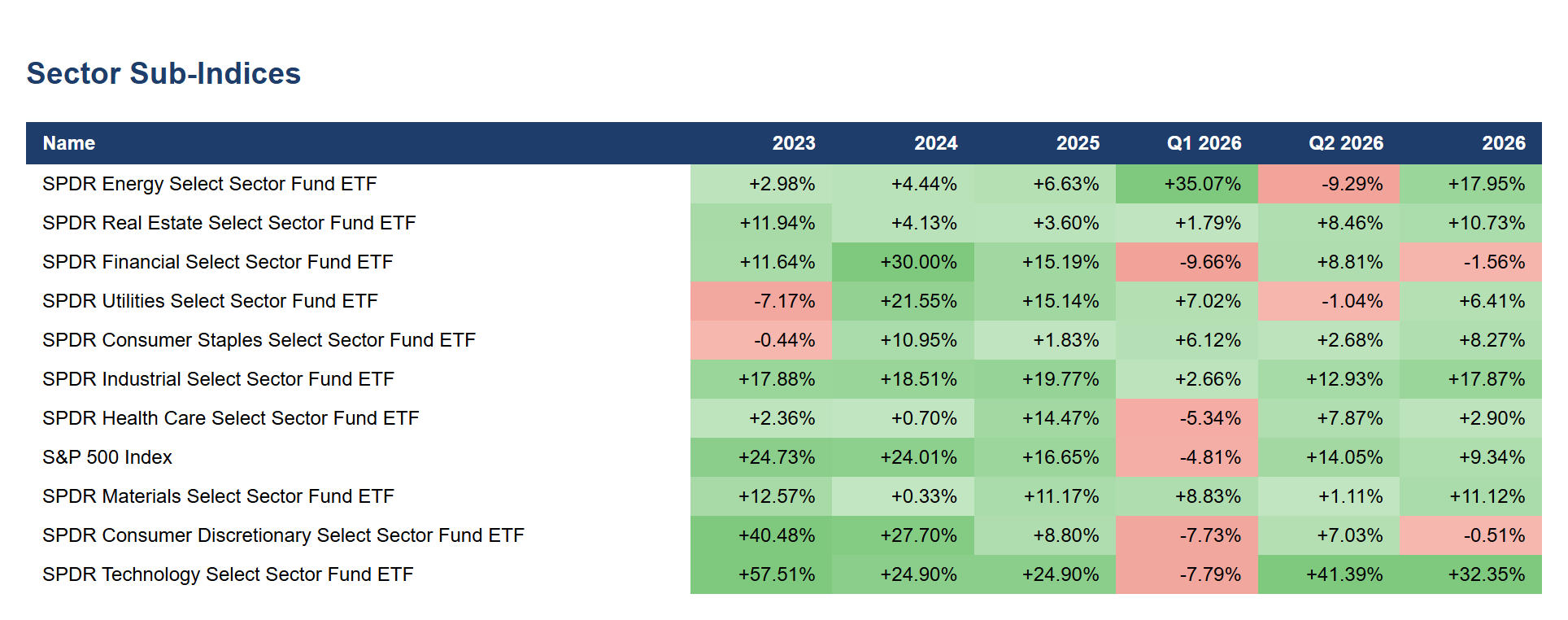
Despite the more hawkish Fed rhetoric and stubborn inflation, equity markets staged one of their strongest runs in years. The S&P 500 gained roughly 14 percent for the quarter, driven by a veritable explosion in semiconductors – the Philadelphia Semiconductor Index (SOX) surged around 74 percent, its best quarter on record. The technology sector overall gained more than 40 percent for the quarter. From early June, the first signs of fatigue appeared: the “Magnificent Seven” fell roughly 7 percent in the second half of June – an early sign that the valuation debate hasn’t gone away despite the rally.
On the trade front, the legal rollercoaster that began in the first quarter continued: the new, Section 122-based 15 percent tariff was itself ruled unlawful on 7 May by the U.S. Court of International Trade, in a narrow 2-1 decision. The practical impact remained limited for now – the ruling directly binds only the three plaintiffs, the administration immediately appealed, and the appeals court issued a stay as early as 12 May. The tariff therefore remains in force for the time being, though legal uncertainty for importers and businesses persists. The DAX initially corrected sharply in April in the aftermath of the Iran conflict, before recovering as tensions in the Gulf eased. The Swiss Market Index proved more resilient than its German neighbor, gaining nearly 9 percent for the quarter.
Our Assessment
One topic that took a back seat in the headlines during the second quarter to the Iran conflict and the Fed leadership change is, over the long run, at least as significant: US fiscal policy. US federal debt crossed the USD 40 trillion mark during the period, and the monthly budget deficit remains at record levels. Taken on its own, this is a picture we have repeatedly flagged with concern in previous editions of this Navigator.
Treasury Secretary Scott Bessent, however, argues that this debt buildup should be assessed fundamentally differently than in the past. The core of his argument is the full and immediate expensing for machinery, equipment, and newly built factory structures enshrined in the “One Big Beautiful Bill” – a provision that meaningfully lowers the cost of capital for building US production capacity and has fueled a genuine investment boom this year, driven by semiconductor, AI infrastructure, and reshoring projects. The near-term revenue loss from this immediate expensing – estimated by the Congressional Budget Office at roughly USD 141 billion over ten years – is, in Bessent’s view, the price of higher structural growth that will, through new jobs and future corporate profits, replenish government revenue over the medium term. The difference from the previous administration, in his repeated framing, lies in what the borrowed money is used for: investment in productive capacity, rather than, as under Biden, primarily consumption-oriented social transfers that generate no earning power of their own.
We find this argument not implausible – investment in physical capital does, unlike pure transfer payments, carry some probability of future productivity gains. At the same time, history shows that revenue losses from investment incentives rarely fully pay for themselves – “this time is different” has often been the most expensive phrase in fiscal history. For us, then, the real referee isn’t the rhetoric but the bond market: as long as the term premium at the long end of the US curve doesn’t come down meaningfully, the market is pricing this bet as riskier than Washington is communicating. It’s worth tracking in this Navigator over the coming quarters.
Outlook
The new Fed course under Kevin Warsh is likely to define the second half of the year: should inflation continue to ease as suggested in June, the hawkish rhetoric could prove to be a temporary “opening statement.” If inflation instead proves sticky – not least because of structurally higher energy prices since the Iran conflict – the rate pause could last considerably longer than the strongly-performing equity market currently prices in.
After the spectacular run in technology and semiconductors, we counsel discipline on position sizing, not an exit. The structural story around artificial intelligence and automation remains intact, but the speed of recent gains invites profit-taking and a review of portfolio weightings. Gold and silver, more attractively valued after the recent correction, remain for us a sensible counterweight in an environment that, despite the rally, stays fragile.
“Be fearful when others are greedy, and greedy when others are fearful.” – Warren Buffett
Yours, EDURAN AG
Thomas Dubach