

The Navigator provides insight into stock market events with an outlook.
July 7, 2026
“Ceasefire Rally.” What cost the market in oil prices, gold, and nerves in the first quarter, it made up for in interest rates in the second: A ceasefire in the Gulf, a new Fed chair, and a tech sector on a roll helped the S&P 500 post its best quarter since the 2020 COVID-19 rebound.
Market review
After the shock of the first quarter, April brought some initial relief: A ceasefire between Israel and Iran—albeit fragile and accompanied by new tensions well into June—allowed the oil price to pull back from its peak above USD 100. Gold, which had already plummeted in the first quarter, lost even more ground: from January’s highs of around USD 5,600 to an interim low of around USD 3,960, before stabilizing around the time of the ceasefire (April 8) to around USD 4,850. Silver followed the same pattern, falling significantly from its record highs of around USD 120.
The change in leadership at the U.S. Federal Reserve caused a stir in May and June: On May 13, the Senate confirmed Kevin Warsh as the new chairman in one of the closest and most controversial votes in Fed history (54–45); he was sworn in on May 22. At his first meeting as chairman (June 17), Warsh struck a significantly more restrictive tone than his predecessor—the previous wording indicating a “propensity to cut interest rates” was removed, and potential rate cuts were pushed back toward 2027–28. The federal funds rate remained at 3.50–3.75 percent. The ECB, by contrast, raised its rate unexpectedly on June 18 by 25 basis points to 2.25 percent, after inflation in the eurozone was on track to reach around 3 percent for the current year—a direct consequence of the oil price shock from the first quarter. In the U.S., consumer inflation climbed to 4.2 percent in May—the highest level since 2023 (gas prices up 40.5 percent year-over-year)—before falling back to 3.5 percent in June as the oil market eased.
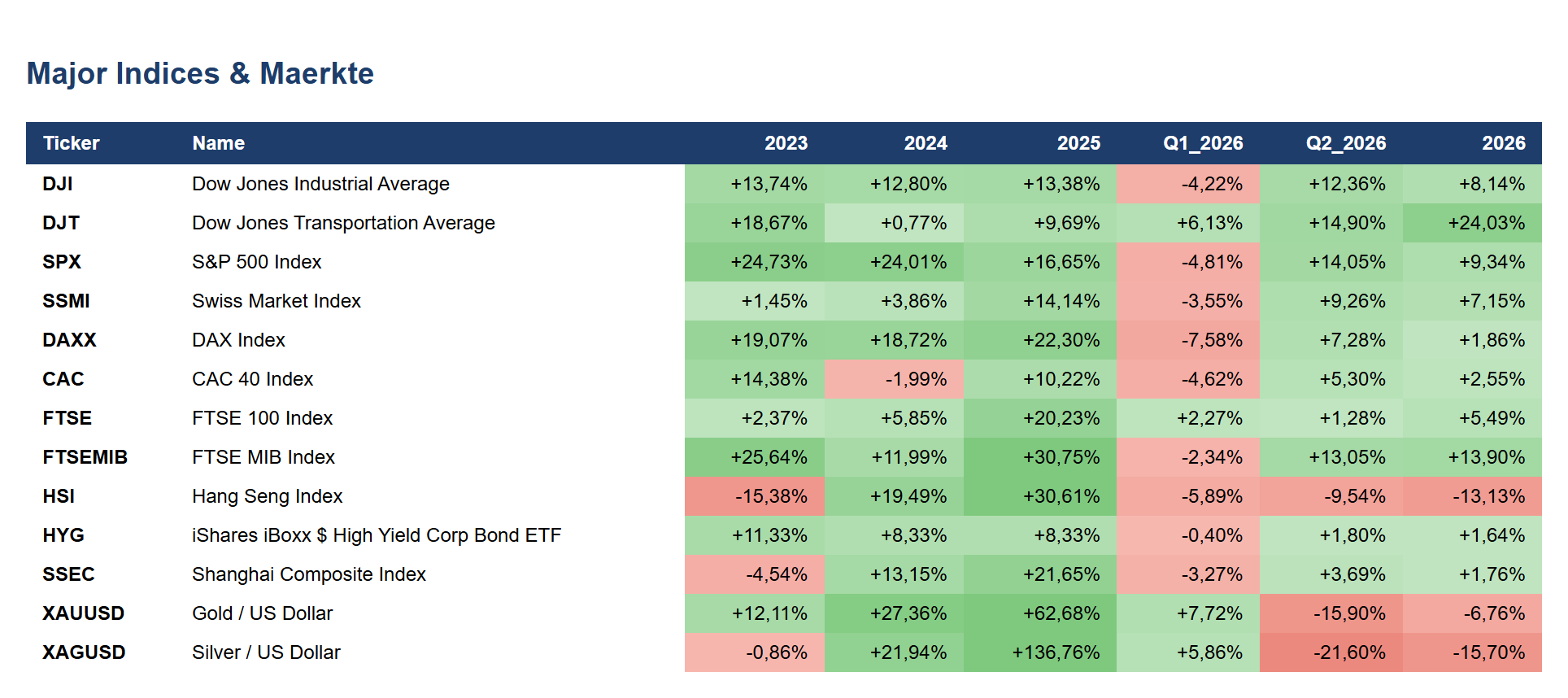
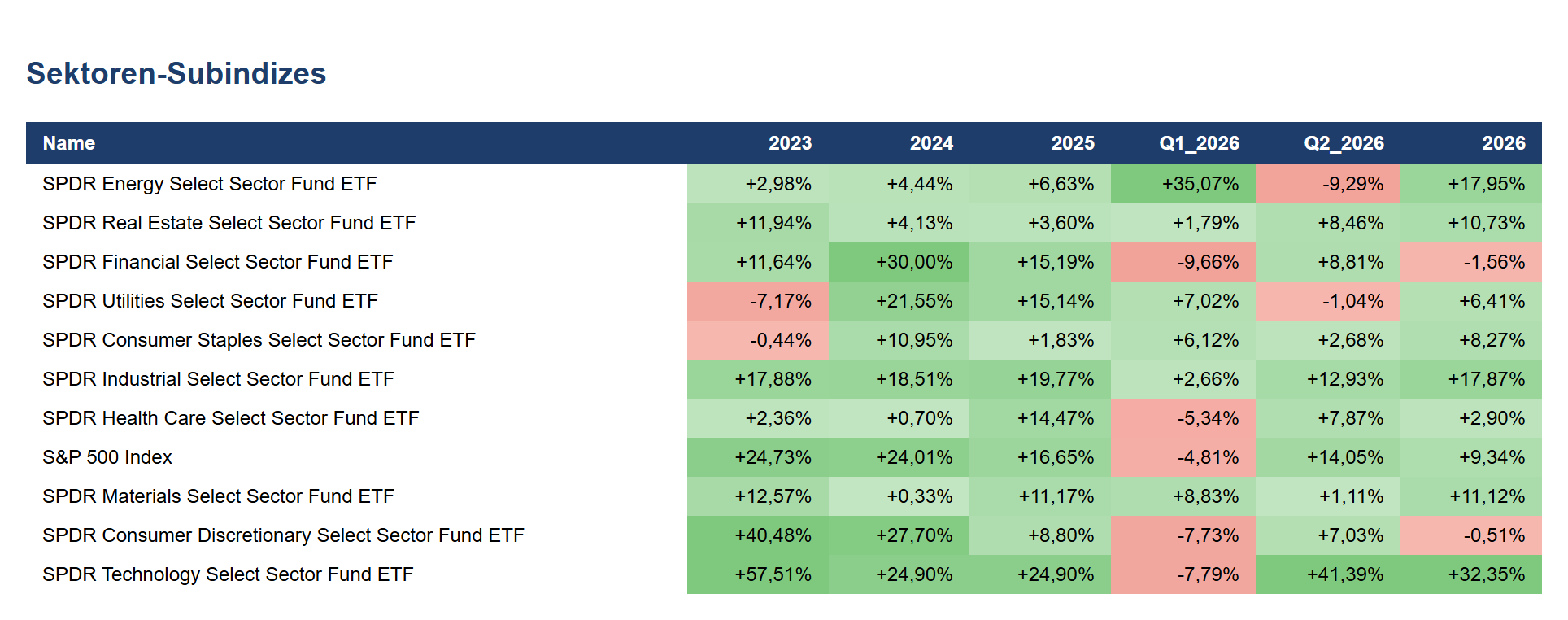
Despite the Fed’s more hawkish rhetoric and persistent inflation, the stock markets posted one of their strongest runs in recent years. The S&P 500 gained about 14 percent over the quarter, driven by a veritable explosion in the semiconductor sector—the Philadelphia Semiconductor Index (SOX) rose by about 74 percent, marking its best quarter on record. The technology sector as a whole gained over 40 percent during the quarter. By early June, the first signs of fatigue began to appear: The “Magnificent Seven” fell by about 7 percent in the second half of June—an early indication that the valuation debate has not gone away, despite the rally.
On the tariff front, the legal roller coaster ride that began in the first quarter continued: The new 15 percent tariff, based on Section 122, was also ruled unlawful by the U.S. Court of International Trade on May 7 in a narrow 2-to-1 decision. The practical impact remained limited for the time being—the ruling is directly binding only on the three plaintiffs; the government immediately filed an appeal, and the appellate court provisionally stayed the ruling as early as May 12. The tariff thus remains in effect for the time being, but legal uncertainty for importers and companies persists. The DAX initially corrected sharply in April in the wake of the Iran crisis before recovering as tensions in the Gulf de-escalated. With a quarterly gain of just under 9 percent, the Swiss Market Index proved more resilient than its German counterpart.
In focus
One topic that took a back seat in the headlines during the second quarter—behind the Iran conflict and the Fed leadership changes—is at least as significant in the long term: U.S. fiscal policy. During the reporting period, U.S. national debt surpassed the USD 40 trillion mark, and the monthly budget deficit remains at record levels. Taken on its own, this is a situation we have repeatedly commented on with concern in previous issues of this Navigator.
Treasury Secretary Scott Bessent, however, argues that this borrowing should be viewed in a fundamentally different light than in the past. Central to his argument is the “full expensing” provision for machinery, equipment, and newly constructed factory buildings—a measure that significantly lowers the cost of capital for building production capacity in the U.S. and has triggered a veritable investment boom this year, driven by semiconductor, AI infrastructure, and reshoring projects. The short-term tax revenue losses resulting from this full expensing—estimated by the Congressional Budget Office at approximately $141 billion over ten years—are, according to Bessent, the price to pay for higher structural growth, which will replenish government revenues in the medium term through new jobs and future corporate profits. The difference from the previous administration, according to his repeatedly stated argument, lies in the purpose of the debt: investments in productive capacity rather than—as under Biden—primarily consumptive social transfers that do not generate their own revenue.
We do not consider this line of reasoning implausible—unlike pure transfer payments, investments in physical capital do indeed carry a certain probability of future productivity gains. At the same time, history shows that tax revenue losses resulting from investment incentives rarely pay for themselves entirely—“this time it’s different” has often been the most costly statement in fiscal history. For us, therefore, it is not rhetoric but the bond market that remains the true arbiter: As long as the term premium at the long end of the U.S. yield curve does not decline noticeably, the market is pricing in a higher risk for this bet than Washington is suggesting. It will be worth continuing to monitor this in the Navigator over the coming quarters.
Outlook
The Fed’s new course under Kevin Warsh is likely to shape the first half of the year: If inflation continues to ease as suggested in June, the hawkish rhetoric could prove to be a temporary “starting signal.” If, on the other hand, inflation remains stubborn—not least due to structurally higher energy prices since the Iran conflict—the pause in interest rate hikes could last significantly longer than the strong stock market is currently pricing in.
Following the spectacular rally in the technology and semiconductor sectors, we urge investors to exercise discipline regarding position sizing—not to exit their positions. The structural narrative surrounding artificial intelligence and automation remains intact, but the pace of recent price gains calls for profit-taking and a review of portfolio weightings. Gold and silver, which have become more attractively valued following the correction of the past few months, remain, in our view, a sensible counterposition in an environment that remains fragile despite the rally.
“Be fearful when others are greedy, and be greedy when others are fearful.” – Warren Buffett
Your EDURAN AG
Thomas Dubach