

Spotlight sheds light on a topic of interest or current relevance.
06 September 2026
Lacy Hunt, for decades the best-known proponent of the deflation thesis, now sees inflation as the greater risk of the coming years. Capital scarcity, the end of globalization and runaway government deficits, in his view, point to structurally higher prices and interest rates. We put his argument in context – and highlight a force we would weigh at least as heavily.
Lacy Hunt's U-Turn: Why "Dr. Deflation" Now Warns of Inflation
When an economist who spent his entire career as a champion of the deflation thesis publicly changes his mind, it’s worth paying close attention. Lacy Hunt, chief economist at Hoisington Investment Management and a former senior economist at the Federal Reserve, did exactly that in his latest quarterly letter – and laid out his reasoning in a detailed conversation with Adam Taggart of Thoughtful Money, joined by Brent Johnson of Santiago Capital.
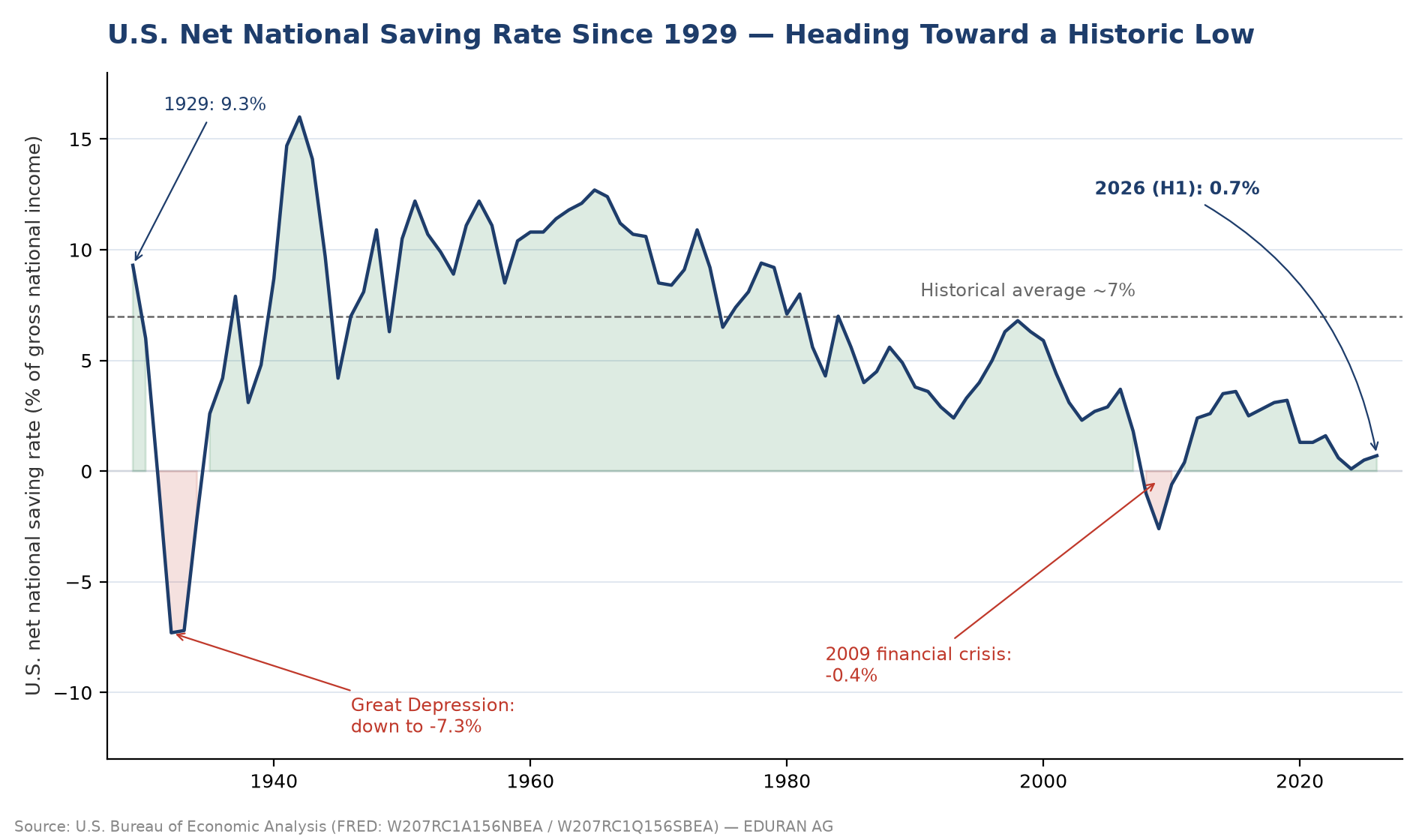
Hunt’s thesis can be traced to a structural double-whammy: capital scarcity on one side, the end of three decades of globalization on the other. The US net national saving rate – what households, businesses, government, and the rest of the world together effectively set aside – is near zero, a level previously reached only in 1929 and during the financial crisis. At the same time, demand for capital for physical investment is exploding: building AI infrastructure, expanding semiconductor capacity, the overdue upgrade of the power grid, plus space projects and a growing federal deficit. When such high investment demand meets such scarce savings, real interest rates must rise, in Hunt’s reading – a simple but uncomfortable economic relationship.
The second pillar of his argument is the reversal of globalization. The disinflationary tailwind of past decades came from hundreds of millions of workers entering the global production process after the end of the Cold War, amplified by enormous economies of scale. Today that wind is turning: resilience trumps efficiency, “just-in-case” replaces “just-in-time,” supply chains are being reshored or spread across allied nations – structurally more expensive, whatever one’s politics. Even artificial intelligence, which many see as a disinflationary productivity boost, works in the opposite direction for now, in Hunt’s view: building the necessary infrastructure consumes energy, capital, and grid capacity, while any productivity gain – if it materializes at all on this scale – would only show up later in the cycle.
Hunt doesn’t mince words on the fiscal situation. The estimate for the current US budget deficit jumped within ten days from roughly USD 1.7–1.8 trillion to USD 2.1 trillion – from 5.8 to 6.4 percent of GDP. The reason: the administration wants to spend more on defense, the opposition wants more social spending, and historically Washington rarely resolves such conflicts through compromise, but through doing both at once. Federal debt is approaching 120 percent of GDP, on track toward 130 percent. Hunt cites economic historian Niall Ferguson, who observes that great empires begin to decline once their interest expense exceeds defense spending – a threshold Hunt believes the US is nearing.
Hunt is equally sharp on recent monetary policy. Since December, he says, the Fed has absorbed roughly USD 1.5 trillion in Treasury securities through “stealth easing,” while bank balance sheets expand sharply and the velocity of money (M2) has risen from 1.1 to 1.4 – clearly inflationary in his view. He’s especially critical of the recent intervention by Treasury Secretary Scott Bessent, who is buying additional long-dated bonds to push down long-end yields. For Hunt, that’s a “gimmick” that contradicts the stated goal of new Fed Chair Kevin Warsh to let the market send an undistorted signal. His conclusion: the bond market is ultimately more powerful than any Treasury secretary.
His analytical framework is the Fisher equation, under which the nominal bond yield equals the real rate plus expected inflation plus a risk premium. All three components, Hunt argues, are pointing higher: the real rate because of capital scarcity; inflation expectations because money supply growth of roughly 7.5 percent a year runs well above the 4 to 4.5 percent implied by Milton Friedman’s optimal-growth rule – a rule tied to the slowing potential growth rate driven by weak demographics; and the risk premium because of the political inability to get the deficit under control. One side effect Hunt highlights specifically: higher rates disproportionately benefit the top two income deciles, who hold savings, while hurting the bottom eight, who rely on credit – a distributional effect that deepens the economy’s already K-shaped divergence.
For investors, Hunt draws a clear, if uncomfortable, conclusion: in a structurally inflationary environment with rising rates, it’s hard to be bullish on bonds. Real assets and precious metals, whose intrinsic value can’t easily be defined away, should relatively outperform. He expects near-term dollar weakness, though no other currency is positioned to take over its role – more of a back-and-forth than a clear directional trend.
What stands out in this conversation, however, is that Brent Johnson – known as the creator of the “Dollar Milkshake” thesis – doesn’t so much contradict Hunt’s analysis as deepen it. He asks whether higher rates aren’t also stimulative, since interest payments flow back into the economy – Hunt counters by pointing again to the regressive distributional effect already noted. Johnson also raises the idea that large technology companies, with their enormous, partly debt-financed investments in AI infrastructure (roughly USD 800 billion this year alone), are effectively crowding the government out of the bond market and thereby pushing yields higher themselves – a reversal of the classic “crowding-out” argument. The one point where Hunt pushes back directly is on whether Bessent’s bond purchases are more about supporting bank balance sheets than government funding costs: the average maturity of Treasury holdings at banks is under five years, Hunt notes, and banks simply aren’t buyers of long-dated securities. Johnson’s own, more dollar-bullish view doesn’t come up in this conversation – it’s set to be presented at Thoughtful Money’s fall conference in October.
Our Assessment
For all the persuasiveness of Hunt’s argument, we wouldn’t underestimate a countervailing force that only comes up in passing in this conversation: the interplay between the technology revolution and demographics. Hunt himself treats weakening demographics – a stagnant or shrinking workforce – as inflationary, since it limits potential growth and thus labor supply. Historically, however, the opposite tends to hold true: aging, shrinking societies – Japan is the textbook example of the last three decades – tend toward weak demand and subdued consumption, and thus toward disinflation or even deflation, not price pressure. Combined with an AI and automation wave that – unlike what Hunt describes for the near term – could deliver over the medium term exactly the kind of productivity gains that past technological leaps have brought, a renewed disinflationary or even deflationary phase wouldn’t surprise us.
The decisive caveat here is politics. Since the Covid pandemic, governments have had access to a tool they had barely used before: direct fiscal stimulus – money pumped straight into the real economy through transfer payments, rather than merely trickling through the banking system via monetary policy. This is precisely the tool Lacy Hunt himself cites as one of the reasons behind his change of view. Whether the natural disinflationary force of technology and demographics ultimately prevails depends less on the economy itself than on whether policymakers hold back in the future, or whether fiscal stimulus becomes the new normal. That, for us, remains the central open question of the coming years – not inflation or deflation as a law of nature, but as the outcome of a political choice.
Yours, EDURAN AG
Thomas Dubach