
The Navigator provides insight into stock markets, with an outlook.
08 April 2026
“Hormuz Shock”. The year began quietly, with a central bank in wait-and-see mode and gold on a record run. Then the US and Israel struck Iran – and within days, a monetary policy breather turned into the biggest geopolitical shock to markets in years.
Market Review
The first quarter of 2026 splits cleanly into two distinct phases. The first, through late February, was defined by monetary calm: the US Fed held rates steady in January at 3.50–3.75 percent, having already cut three times the previous year – a deliberate pause to gauge the effects. The ECB (2.00 percent) and the SNB (0.00 percent) also held still. Gold used this calm backdrop for a spectacular run: from around USD 4,330 at the start of the year, it climbed to an all-time high of roughly USD 5,600 an ounce by 28 January – driven by rate-cut expectations, a weak dollar, and continued central bank demand. The Swiss Market Index benefited from the calm environment and strength in Nestlé, Roche, and Novartis, hitting a new record above 14,000 points on 24 February.
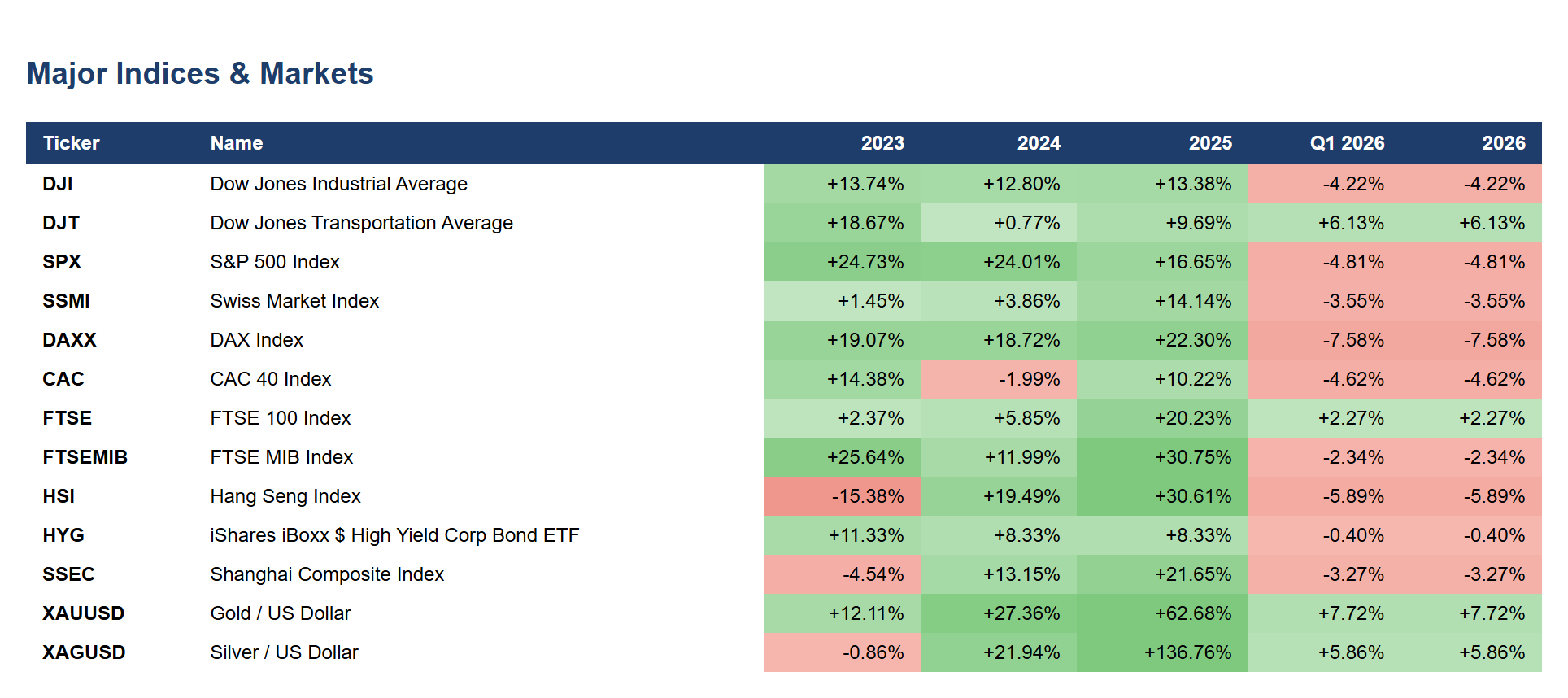
The second phase began on 28 February with a scale that surprised even hardened observers: in a mere twelve-hour operation, the US and Israel carried out nearly 900 strikes on Iranian missile sites, air defenses, military infrastructure, and the leadership – Iran’s supreme leader, Ali Khamenei, was killed in the process. Iran retaliated with strikes on American bases in six countries across the region (including Iraq, Jordan, Bahrain, Qatar, Kuwait, and the UAE) and threatened to close the Strait of Hormuz, through which roughly a third of the world’s crude oil exports and around 20 percent of global LNG pass. Air traffic and shipping in the Middle East ground to a halt in places. Oil (Brent) jumped from USD 71 to over USD 77 within a few days and broke back above USD 100 a barrel on 9 March for the first time since 2022. Gold, which should have benefited from the crisis, initially did the opposite: after its blistering January high, it corrected sharply to around USD 4,100 – its worst month in over a decade, driven by profit-taking and a scramble for liquidity in a jittery market.
Equity markets pulled back: the S&P 500 lost roughly 4.8 percent net over the quarter, the Nasdaq considerably more, with losses concentrated mainly in the final five weeks of the quarter – a roughly 8 percent drop from its interim high, without formally reaching correction territory (-10 percent). Notably, market breadth improved at the same time, with nearly 58 percent of S&P constituents outperforming the index overall – a sign that the large technology names are no longer the sole driver of the market.
As if that weren’t enough, the US Supreme Court struck down on 20 February, in a 6-3 ruling, the legal basis (IEEPA) for most of the previous year’s “reciprocal” tariffs – ruling that tariff and tax authority constitutionally belongs to Congress, not the President. The administration responded almost immediately: four days later, on 24 February, the invalidated tariffs were replaced with a new global tariff based on the Trade Act – initially announced at 10 percent, but raised to the statutory maximum of 15 percent just two days before taking effect. This instrument is limited by law to 150 days. A legal victory with, for now, very limited practical impact.
In Focus
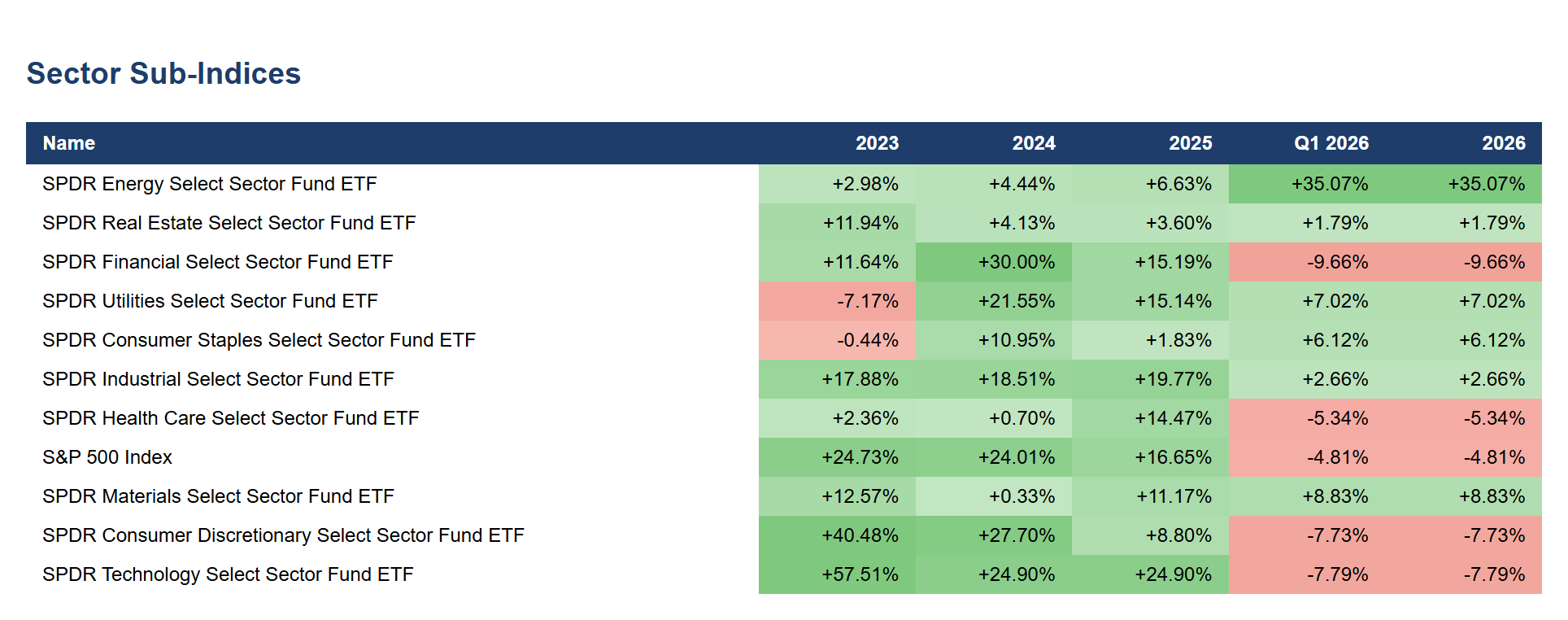
The most striking development of the quarter wasn’t the oil price or the equity pullback, but the sector rotation triggered by the Iran conflict. The energy sector gained more than 35 percent for the quarter – a magnitude we last saw in the months following the outbreak of war in Ukraine. At the same time, technology and cyclical consumer stocks each fell roughly 8 percent. A rotation this sharp, occurring within a matter of weeks, is a warning sign for any portfolio concentrated in the well-known winners of recent years.
It’s also worth noting how gold behaved during this crisis. Gold is traditionally considered the safe haven par excellence in geopolitical crises – and indeed, one might have expected a further rally after 28 February. Instead, it suffered one of its sharpest corrections in a decade. Our interpretation: after the spectacular run of recent years (see previous editions of the Navigator on the gold rally), a lot of “good news” was already priced in, and the crisis itself, counterintuitively, primarily triggered a need for liquidity – positions were sold to cover losses elsewhere, not to add exposure. A pattern we’ve observed in previous shock episodes (e.g., March 2020): even assets considered “safe havens” are not immune to selling pressure in the first, panicked phase of a shock.
For us, the central question remains how long the conflict in the Gulf will persist and whether oil prices will stay elevated. A structurally higher oil price would inevitably reignite the inflation debate that had calmed over the past two years – just as central banks were positioning for a policy shift.
Outlook
The new trade-law-based tariff expires by law after 150 days, i.e. during the third quarter – a date we’re watching closely. More important, however, is how the situation in the Gulf develops: a quick de-escalation would normalize oil prices and take the edge off inflation weighed down by high energy costs. If the conflict persists or widens, central banks risk being caught between growth weakness and imported inflation – a combination that makes neither rate cuts nor hikes straightforward.
We remain invested, with a focus on quality and broad diversification across sectors. This quarter’s sharp rotation showed just how quickly market leadership can shift – one more reason not to concentrate on themes that worked in the past.
“Oil is like a wild animal. Anyone who wants to tame it must first learn to fear it.” – Daniel Yergin
Yours, EDURAN AG
Thomas Dubach