
The Navigator provides insight into stock markets, with an outlook.
07 July 2025
“Tariff Shock”. Within a few weeks, markets went through one of the sharpest sell-offs and the strongest rebounds in recent history – triggered, intensified, and ultimately cushioned by the same source: trade policy out of Washington. By the end of the first half, the US dollar had posted its weakest first half since 1973, gold was hitting record highs, and markets proved more resilient than the headlines suggested.
Market Review
The first half of 2025 began with a shock few had expected on this scale. In late January, the announcement of the Chinese AI model DeepSeek triggered one of the largest single-day losses in stock market history: Nvidia lost around 17 percent of its value – nearly USD 600 billion in market capitalization – in a single day, while the Nasdaq fell roughly 3 percent. A first taste of just how nervous and concentrated the market has become around the handful of large technology stocks that have carried the indices in recent years.
The real break came on 2 April, the day the US administration itself dubbed “Liberation Day”: a global baseline tariff of 10 percent, plus country-specific “reciprocal” tariffs ranging from 10 to 46 percent – briefly as high as 145 percent against China – sent the S&P 500 tumbling roughly 10 to 12 percent over two trading days, the largest two-day drop in the index’s history. Around USD 6.6 trillion in market value evaporated. China retaliated immediately with its own 34 percent tariffs. The market reaction was so severe that the administration announced a 90-day pause on the reciprocal tariffs just days later – and markets responded with one of the strongest single-day rallies in decades (+9.5 percent). By the end of April, the S&P 500 was down just 0.76 percent for the month – as if nothing had happened.
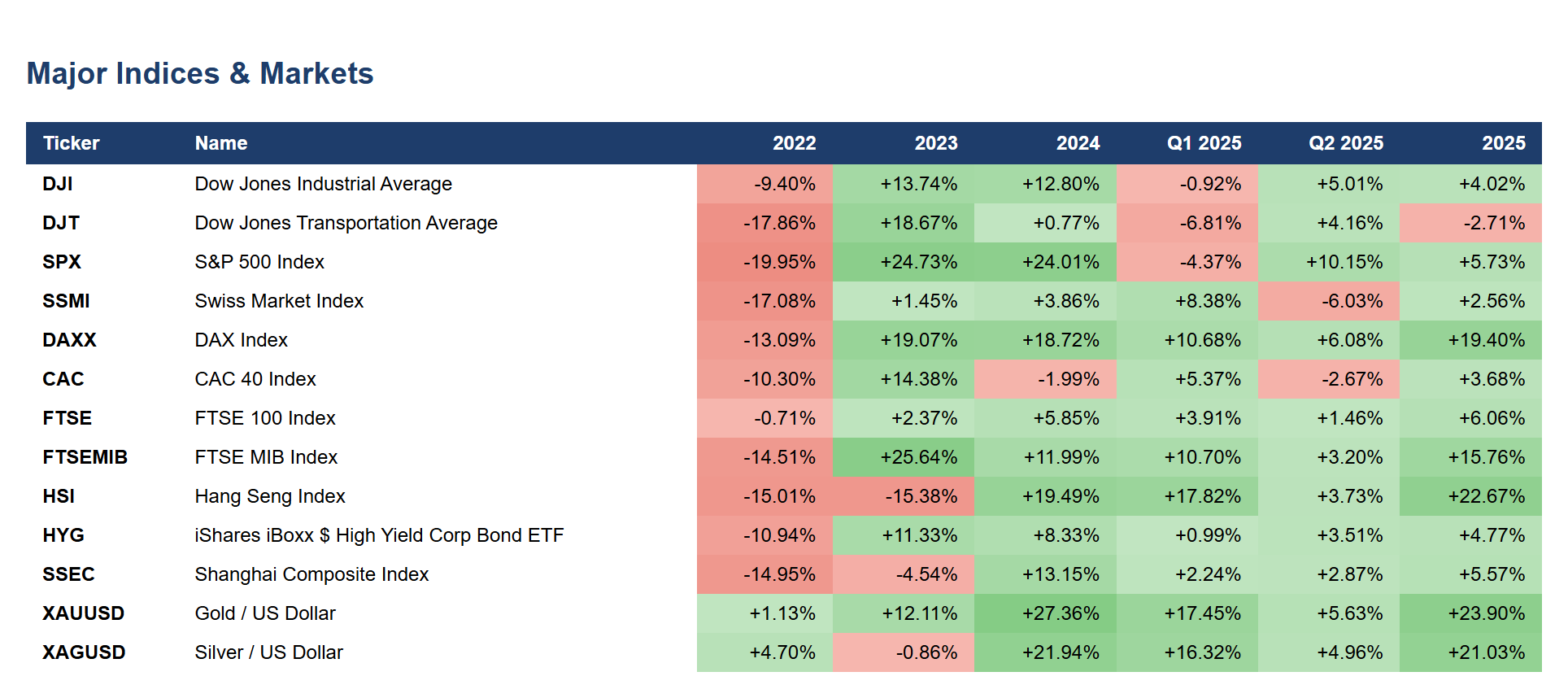
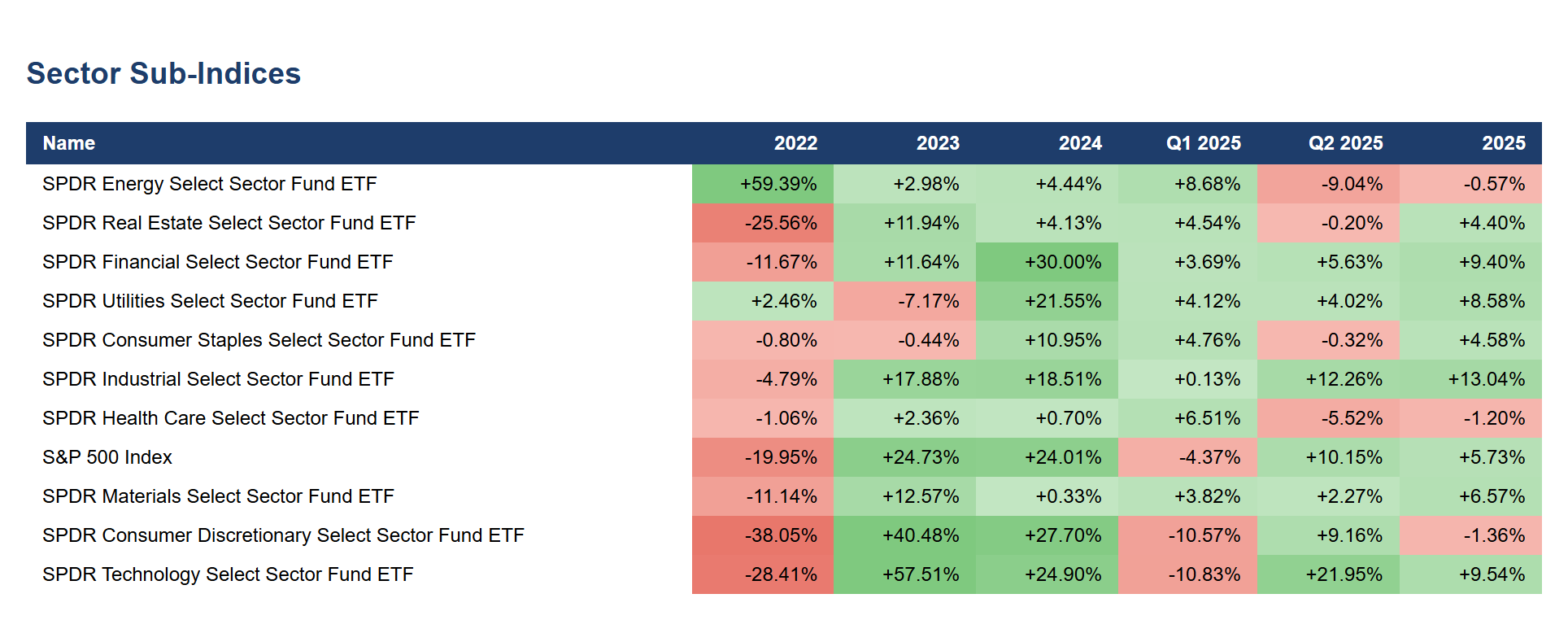
Had nothing happened? Not quite. The dollar never recovered from the shock. The Dollar Index fell 10.8 percent in the first half – its weakest start to a year since 1973 – and roughly 14 percent against the Swiss franc. Capital sought new destinations: European bank stocks gained more than 50 percent over the half, versus roughly 14.5 percent for US banks, and the DAX was among the biggest winners with a gain of nearly 20 percent. The expectation had been that capital would flow into the US – instead, it increasingly flowed out.
On rates, the US Fed held steady at 4.25–4.50 percent, while the ECB cut four times over the half, most recently to 2.00 percent in early June – and the SNB cut its policy rate to 0.00 percent on 19 June, citing deflation risk (May inflation: -0.1 percent) and franc strength. The door to negative rates was deliberately left ajar.
In mid-May came another historic event: Moody’s stripped the US of its last remaining Aaa rating, downgrading it to Aa1 – citing a structural deficit of roughly 9 percent of GDP. The 30-year yield briefly touched the 5 percent mark. And on 13 June, shortly before half-year end, Israel struck Iran – oil prices posted their largest single-day jump since the Russian invasion of 2022, and equity markets pulled back. A preview of what the third quarter would bring.
In Focus
What concerns us most about the first half of 2025 isn’t the tariff shock itself – such events have always occurred, and markets have shown they can digest such shocks within weeks, as long as central banks and fiscal policy stand ready in the background. What concerns us is the dollar’s reaction. A country that imposes tariffs by decree, expecting capital to flow inward as the trade balance improves – and instead sees its own currency lose value while gold and the euro area benefit from the flight of capital, is sending a signal that goes beyond day-to-day politics: confidence in the US as a safe haven is showing cracks.
We have repeatedly noted in previous editions of the Navigator that the high and rising debt levels of Western nations would eventually come at a cost. May’s downgrade by Moody’s is a first, visible signal of that – not the last. At the same time, the dollar sell-off shows that investors have begun diversifying their reserves, moving away from concentration in a single currency and a single economy. That also explains why gold saw its strongest inflows since 2020 in the first half, and why European markets – long shunned as “uninvestable” – were suddenly in demand again.
The DeepSeek shock in January, meanwhile, reminded us just how concentrated risk has become in today’s market. A single event in a single market segment – artificial intelligence – can wipe out nearly USD 600 billion in value within hours. That’s not a reason to abandon the AI theme, since its structural potential remains beyond question. But it is a reason to stay mindful of the concentration risk that has built up in the major US indices over the years.
Outlook
The 90-day tariff reprieve from April expires during the third quarter, and the escalation with Iran that marked the final days of June had not been resolved by half-year end. Both are fault lines likely to shape the second half. We expect trade policy to continue being used as a negotiating tool rather than a permanent state of affairs – April’s market reaction showed that even an administration bent on confrontation has a pain threshold.
We don’t expect a quick turnaround for the dollar. Structurally high debt, a hesitant central bank, and a trade conflict pushing capital toward diversification all point toward continued weakness rather than a V-shaped recovery. Gold and real assets remain a sensible allocation in this environment – not as a bet on further gains, but as insurance against exactly the kind of political surprise risk that defined this half-year.
“The stock market is a device for transferring money from the impatient to the patient.” – Warren Buffett
Yours, EDURAN AG
Thomas Dubach